

 See My Latest Article on HelloNation
What actually makes a supercar fast?
A supercar’s speed comes from the interaction of power, weight, tires, aerodynamics, braking, and electronic control. A large engine alone is not enough; the car must convert energy into motion while maintaining traction and stability.
For local residents, the most useful distinction is between straight-line speed and overall performance. A vehicle may accelerate rapidly but still be less capable through corners or under braking. The quickest cars are engineered as complete systems, with every component working within narrow limits.
How does engine power affect acceleration?
Engine power determines how quickly a car can continue accelerating, especially at higher speeds. Torque helps the car begin moving and build speed, while horsepower describes how effectively the engine can continue producing work as engine speed rises.
Acceleration also depends on:
- Vehicle weight
- Gear ratios
- Drivetrain layout
- Tire grip
- Launch-control programming
- Air resistance
A lighter car needs less force to accelerate. This is why reducing weight can improve performance without increasing engine output. Carbon-fiber structures, lightweight wheels, compact seats, and carefully designed suspension components all help reduce the mass that must be moved.
The transmission matters as well. Closely spaced gear ratios keep the engine operating near its most effective range. Fast gear changes reduce the time between power delivery, although a rapid shift is useful only if the tires can accept the available force.
Why can two cars with similar horsepower perform differently?
Power-to-weight ratio is one major reason. A 700-horsepower car weighing considerably less may accelerate faster than a heavier car with the same engine output.
Traction is another. If the driven tires cannot transfer the engine’s force to the pavement, additional horsepower simply produces wheelspin. All-wheel-drive systems can distribute torque among more tires, while rear-wheel-drive layouts may provide advantages in weight distribution and mechanical simplicity.
Electronic controls also influence the result. Traction control can reduce engine output when slip becomes excessive. Launch control coordinates engine speed, clutch engagement, transmission behavior, and tire slip to produce a repeatable start. These systems do not create grip; they help use the available grip more consistently.
How do tires create so much grip?
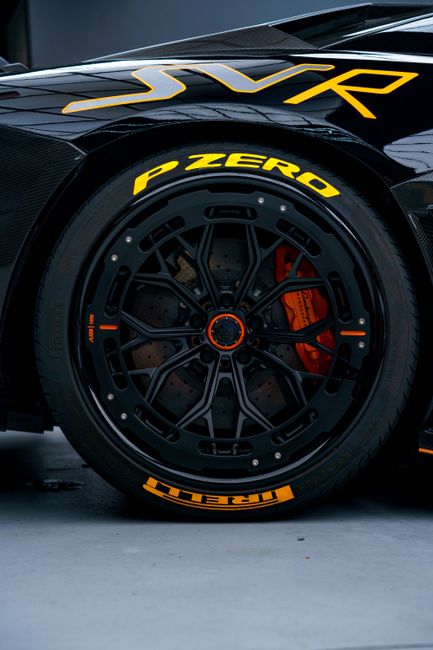
Tires are the only parts of the vehicle touching the road, so their behavior places a hard limit on acceleration, braking, and cornering.
Grip depends on the rubber compound, tire temperature, inflation pressure, road texture, vertical load, and the direction of the forces acting on the tire. A tire can accelerate, brake, and turn at the same time, but its total available grip is limited. Using most of that grip for cornering leaves less available for acceleration.
This is sometimes described as a traction circle. If a driver enters a bend while braking heavily and then applies power abruptly, the tires may exceed their combined limit. The result can be understeer, oversteer, or electronic intervention.
Warm, dry pavement generally provides more predictable grip than cold or wet pavement. In Costa Mesa, seasonal rain, cooler mornings, roadway dust, and summer heat can all change how quickly tires reach their operating range. A car that feels exceptionally stable on a closed circuit may respond differently on ordinary public roads.
What does aerodynamics do?
Aerodynamics manages how air flows around and beneath the car. It affects both drag, which resists forward motion, and downforce, which presses the tires toward the pavement.
At higher speeds, carefully shaped bodywork can create downforce that increases tire loading without adding physical weight to the car. This can improve braking and cornering grip. Splitters, wings, diffusers, underbody channels, and carefully shaped body panels may all contribute to the aerodynamic balance.
The tradeoff is drag. A large rear wing may improve cornering stability but create more resistance on a straight road. Some high-performance vehicles use active aerodynamic surfaces that change position depending on whether the priority is low drag, strong braking stability, or cornering support.
Aerodynamic effects rise rapidly with speed. That means they may be modest at neighborhood speeds but substantial on a racetrack. Downforce should never be interpreted as permission to exceed posted limits; public streets do not provide the controlled surface, visibility, runoff, or traffic conditions required to explore those capabilities safely.
Why is braking part of speed?
A car is only as fast as it can safely slow down. High-performance braking systems use large rotors, strong calipers, heat-resistant materials, and airflow management to convert motion into heat.
Braking performance is affected by:
- Tire grip
- Brake temperature
- Road surface condition
- Vehicle speed
- Brake balance
- Aerodynamic loading
- Driver input
As speed increases, the energy that must be removed rises sharply. Doubling speed requires roughly four times as much kinetic energy to dissipate. This is why repeated high-speed braking can create heat, fade, or changes in pedal feel.
Anti-lock braking systems help prevent wheel lock during hard braking, allowing the driver to retain steering control. They cannot overcome worn tires, standing water, poor visibility, or insufficient stopping distance.
How does suspension help a supercar stay controlled?
Suspension keeps the tires connected to the road while managing body movement. Springs support the vehicle, dampers control motion, anti-roll bars influence cornering balance, and suspension geometry helps maintain useful tire angles.
During acceleration, braking, and cornering, weight shifts between the tires. Engineers tune the suspension so this transfer remains predictable. A low center of gravity reduces body roll, while a wide stance can improve stability. However, an extremely stiff setup may reduce comfort and can become less effective on uneven pavement if the tires lose consistent contact.
This matters in a dense coastal community where road surfaces, driveway transitions, drainage features, and traffic conditions vary. A supercar’s engineering is most effective when the suspension can respond to the actual surface beneath it.
Does lightweight construction matter more than engine size?
Weight reduction improves several parts of performance at once. A lighter vehicle generally accelerates more easily, brakes with less energy, changes direction with less effort, and places less demand on tires and suspension.
Reducing unsprung weight—the mass of wheels, tires, brakes, and suspension components—can be especially valuable. These parts must move up and down over surface changes, so lowering their mass can help the tires follow the pavement more closely.
There are limits, however. Removing too much material can affect durability, noise control, safety, or ride quality. Supercar design is a process of balancing low mass with structural strength, thermal management, occupant protection, and everyday usability.
Why do electronics matter so much?
Modern performance cars use sensors and computers to monitor wheel speed, steering angle, yaw rate, brake pressure, throttle position, and other variables. The control systems can adjust torque, braking force, damping, differential behavior, and aerodynamic settings within fractions of a second.
These systems are best understood as safeguards and optimization tools, not replacements for judgment. They can help correct small losses of traction, but they cannot change the laws of physics or guarantee control in unsafe conditions.
The science behind supercar speed is therefore not just about producing more power. It is about managing energy, air, heat, tire load, and driver input with precision. The result is a machine capable of extreme performance, even though responsible use on public roads still requires restraint, legal compliance, and generous safety margins.